

The answer by car type
| Car | Lease still cheaper than buying by | Advantage lost since 2025 | Verdict |
|---|---|---|---|
| Electric car | 26% | 4% | Best choice |
| Compact petrol (under 4m) | 20% | 29% | Still worth it |
| Mid-size SUV | 21% | 23% | Worth it, check the full quote |
| Large SUV | 23% | 23% | Worth it in a high bracket. Running leases now cost about 10% more a month |
Four-year comparison for an employee in the 30% tax bracket. We compare against a bank car loan at 8.5%, because retail car loans usually cost 2–3 points less than the rate built into a lease. In November 2026, banks advertise car loans from about 8.2–8.7%. How we worked it out is in "The worked example" below.

The three changes
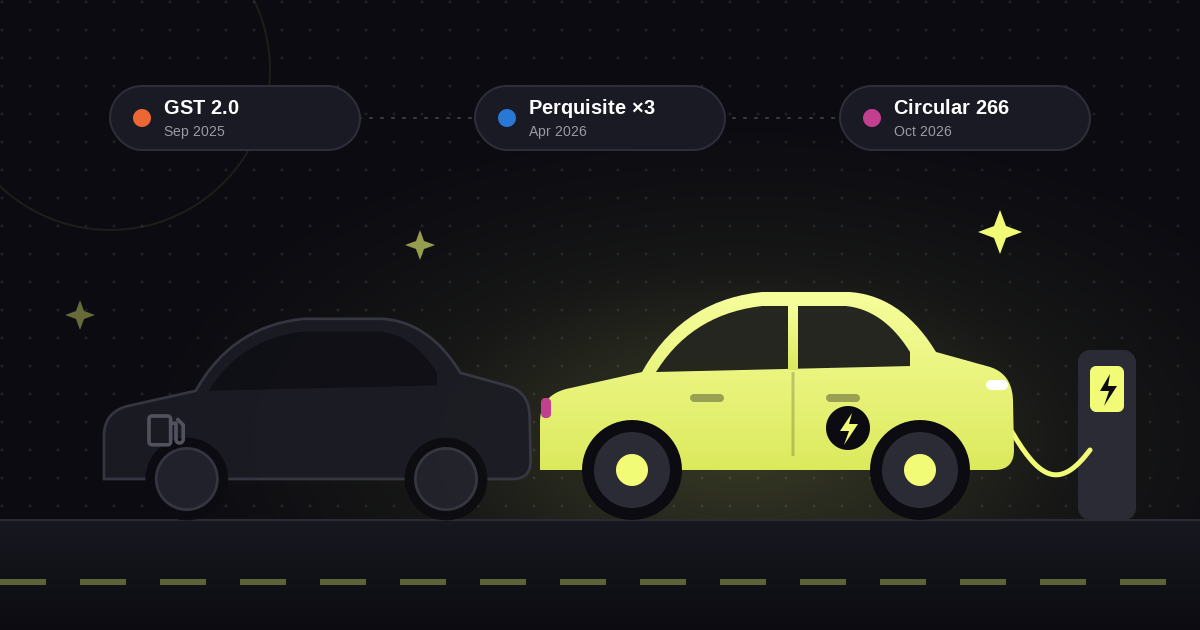
1. GST 2.0 (22 Sep 2025): larger cars moved to 40%
GST on a lease rental follows the GST rate of the car. GST 2.0 replaced 28% plus cess with 18% for small cars (petrol up to 1.2L or diesel up to 1.5L, under 4m) and 40% for larger cars. EVs stayed at 5%.
- Running leases on larger cars got costlier. Lessors paid up to 22% cess when they bought these cars and can no longer use that credit. Many now recover it from lessees with 40% GST on top. Reported increases are about 10% a month. The stuck-credit issue is before the Supreme Court.
- New leases pay the lower rate, but so do buyers. A buyer keeps the whole price cut. A lessee paying from pre-tax salary gets only about 70% of it, so the lease's lead narrows.
2. Higher perquisite (1 Apr 2026): roughly tripled
A company car used for work and personal trips is taxed at a fixed monthly value, not the actual rental. The Income-tax Rules, 2026 raised that value, including on existing leases, and EVs now count as small cars.
| Employer pays running costs | Before | From April 2026 |
|---|---|---|
| Up to 1.6 litres, or EV | ₹1,800 a month | ₹5,000 a month |
| Above 1.6 litres | ₹2,400 a month | ₹7,000 a month |
| Chauffeur (added) | ₹900 a month | ₹3,000 a month |
If the employee pays running costs, the values are ₹2,000 and ₹3,000 a month. In the 30% bracket, the change costs about ₹12,000 a year more in tax for smaller cars and EVs, and ₹17,000 a year for larger ones. A fixed amount bites hardest on small, cheap leases.

3. Circular 266 (28 Oct 2026): road tax and insurance taxed at the car's rate
Lessors pay road tax, registration, insurance and FASTag, then recover them from you. Some billed these with no GST, some at 18%. After the 57th GST Council meeting, CBIC Circular 266/12/2026 made them part of the lease, taxed at the car's rate.
| Recovered in the lease | Often billed before | Large car | Small car | EV |
|---|---|---|---|---|
| Road tax and registration | No GST | 40% | 18% | 5% |
| Insurance | 18% | 40% | 18% | 5% |
Because the circular is framed as a clarification, advisers expect it to reach past invoices too. Advisers read separately contracted maintenance as staying at 18%. EVs gain here: their insurance drops from 18% to 5%.
What should HR, finance and employees do?

HR and finance decide whether to run the program and on what terms; each employee chooses the car. Pausing everything isn't the only option. Keep running leases and audit their invoices, settle back-dated GST and exit terms in the agreement, and show employees the full monthly invoice, GST included. With those numbers, most will find an EV or a small car still makes sense.
Why companies are pausing car lease programs
Leasing companies have paused onboarding of new employers while they rewrite their agreements for Circular 266, and several large employers have paused the benefit. AutoMint has also paused new employer onboarding and new car lease applications, with a few exceptions, until the new agreements are in place.
The pause is about contracts, not employee savings:
- Back-dated GST. If authorities apply Circular 266 to past invoices, someone pays GST on road tax and insurance billed without it.
- Rising rentals on running large-car leases, which land on HR as complaints.
Questions to ask your leasing company
- Are road tax, insurance and FASTag now billed inside the lease at the car's GST rate?
- Will you raise GST on past recoveries, and who pays it under our agreement?
- On running leases, how much stuck cess are you recovering, and over how many months?
- What does an employee pay if they leave mid-lease?
The worked example
Lease vs buy in rupees, and where the advantage went
Four-year cost to the employee after tax, leasing through salary vs buying with a bank car loan at 8.5%, 30% bracket:
| Car | Price before tax | Advantage before | Advantage now | Change |
|---|---|---|---|---|
| Compact petrol | ₹6.5 lakh | ₹3.08 lakh | ₹2.20 lakh (₹4,576 a month) | −29% |
| Mid-size SUV, 1.5L | ₹12 lakh | ₹6.68 lakh | ₹5.13 lakh (₹10,693 a month) | −23% |
| Large SUV, 2.2L diesel | ₹25 lakh | ₹14.62 lakh | ₹11.20 lakh (₹23,344 a month) | −23% |
| Electric car | ₹20 lakh | ₹7.43 lakh | ₹7.13 lakh (₹14,862 a month) | −4% |
Where it went, for a lease signed today:
| Car | GST 2.0 | Perquisite | Road tax and insurance | Total |
|---|---|---|---|---|
| Compact petrol | −₹28,555 | −₹47,923 | −₹11,784 | −₹88,262 |
| Mid-size SUV | −₹23,962 | −₹47,923 | −₹82,785 | −₹1,54,670 |
| Large SUV | −₹99,843 | −₹68,890 | −₹1,72,469 | −₹3,41,202 |
| Electric car | none | −₹47,923 | +₹18,782 | −₹29,141 |
The loan rate matters too. A bank loan at 8.5% instead of the lease's 11% takes about ₹48,000 (compact) to ₹2.2 lakh (large SUV) off the lease's lead over four years. Compare the lease quote with the car loan you could get yourself.
In a lower bracket: at 20% (taxable income ₹16–20 lakh), leasing is still about 11–12% cheaper than buying for petrol and diesel cars, and about 16% for EVs. Below ₹12 lakh taxable income you pay no tax in the new regime, so a lease saves nothing on tax.
Assumptions: new tax regime at a 31.2% marginal rate; 48 months; the lease at 11% and the bank car loan at 8.5%, with the car kept at the end; road tax 10% of ex-showroom (it varies by state; none for the EV); insurance 2.5% a year; employer pays running costs, no chauffeur. "Before" uses pre-September 2025 GST, the old perquisite values, road tax without GST and insurance at 18%. With the loan 2 points cheaper than the lease (9%), leasing is about 21–27% cheaper; 3 points cheaper (8%), about 19–26%; at the same rate as the lease, 24–29%. The ~10% stuck-cess increase on running large-car leases is not included.
Talk to us before you pause
AutoMint runs car and device leasing programs for employers through regulated NBFC partners. New car lease onboarding is paused while agreements are updated. If you're deciding what to do with your company's program, book a call and we'll go through your running leases and the EV options. Employees: we'll update this guide when new car leases open again.
Sources: KPMG on the Income-tax Rules, 2026 · PIB GST rate factsheet · Taxation Post on GST 2.0 and existing leases · Vinod Kothari Consultants on the GST Council decision and Circular 266